20th-century economists often say that there is no better alternative to the capitalist economic system we have now. If that's true, apparently "the best we can do" just happens to be a system that's going to eventually kill the planet, crash the global economic system and destroy human civilization. Really? Call me an optimist but I'm pretty sure humans can design an economic system that doesn't meet its inevitable conclusion by crashing the planetary life-support systems on which humans depend.
But before I get to those alternatives, just to make sure we're all on the same page, here are 9 films that make it painfully clear that our economic system (global capitalism) is fundamentally unsustainable, and on top of that, making a lot of people miserable or unhappy anyway.
 1 min
1 min
|
|
 34 min
|
|
 5 min
5 min
|
|
 18 min
|
|
 21 min
|
|
 93 min
|
|
 7 min
7 min
|
|
 5 min
5 min
|
|
 6 min
6 min
|
|
The good news is, global capitalism predicated on infinite growth on a finite planet is not "the best we can do." There are many beautiful alternatives that would not only be infinitely sustainable (meaning they are grounded in ecological law). They also deliver on the promise that capitalism could never provide. Namely, these alternatives are designed to benefit everyone while respecting the planet, rather than benefiting a few while the global majority remains in poverty and the planet is exploited beyond regenerative levels.
These alternatives go beyond the failed state-capitalist and state-communist models of the past - twin failures that had their critical flaws rooted in an unsustainable paradigm of thinking.
To be a true alternative, it must transcend the way of thinking which created the problem in the first place. It must not simply try to "win" the economic game via the old rules of the past - but must rethink and redesign the game itself.
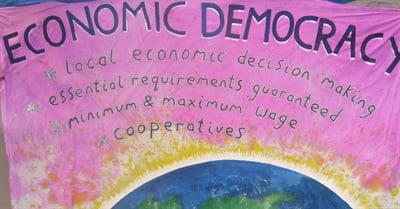
Economic Democracy, PROUT, Communalism, Resourced-Based Economics, and the Economics of Happiness are just 5 similar but different alternatives worth learning more about.
Perhaps you will be involved in thinking of a better alternative yourself. Humans are incredibly inventive creatures. When we believe that we can do better than what we have done in the past, we are capable of amazing innovation and creativity.
Just think, no one says "this is the best computer and will never be surpassed." No one thinks "this is the best automobile and will never be surpassed." So why is it that economists stubbornly hold on to the (very outdated and dangerous) belief that "the economic system we have now is the best and will never be surpassed"?
One thing is clear to me: the days of "one economic system" ruling the entire planet will be over in another 100 years. The answer to a single unsustainable economic system is not a single sustainable, bright and shiny alternative. Searching for the "one true" solution has not got us very far, and always ends with some folks disagreeing and claiming some other system as the one true solution. If humans are still around in 100 years, and ecological feed-back loops didn't crash the biosphere, it will be because humanity deployed and experimented with multiple ecologically harmonious alternatives all across the planet.
Perhaps PROUT will take off in India while Economic Democracy will take off in the US and UK. These alternatives are not super different in their essence but they may have differences in the details. The point is, we need to stop looking for a solution that works for the entire planet and start looking for solutions that are tailored to the cultures and politics of our own countries, which we can start implementing in our own cities, right here and now.
Economic Democracy, Economic Decentralization, and Economic Localization are the 3 big ideas that I believe will guide the transition to a sustainable future. The economic system of the future - one that benefits everyone and respects the planet - is unlikely to be found under any single name or theory. What I expect to see in the future is a patchwork network of alternatives that grow by the merit of their success and the passion with which they are implemented by people like you.
The key is for us all to start thinking like designers and start experimenting and advancing these alternatives in our own cities one project at a time.
And on that note, here are 11 films to inspire the creative systems thinker in us all:
 19 min
|
|
 86 min
|
|
 30 min
|
|
 20 min
|
|
 4 min
4 min
|
|
 10 min
|
|
 59 min
|
|
 59 min
|
|
 7 min
7 min
|
|
 22 min
|
|
 300 min
|
|
LOVE FILMS FOR ACTION?
We don't run on ads. We're run on community. Donating $5/month makes a difference.
Subscribe here.